
AI in Education 2026: How Technology Is Changing Learning
Artificial intelligence truly is one of those breakthroughs in education for 2026 – the year when society has accepted AI into educational processes. However, it’s not enough for school and university teachers to understand how useful artificial intelligence could be, they all have also dedicated time to studying how different concepts could be applied, as well as what specific threats to critical thinking, creativity, and integrity they might impose.
The trend of artificial intelligence in education is beginning to take off. Schools have started the process of introducing AI literacy programs, educators are receiving training in new technologies, and educational authorities are forming standards in responsible technology use. Still, the issues of false information, privacy of data, screen time, and dependency on technology have become more significant.
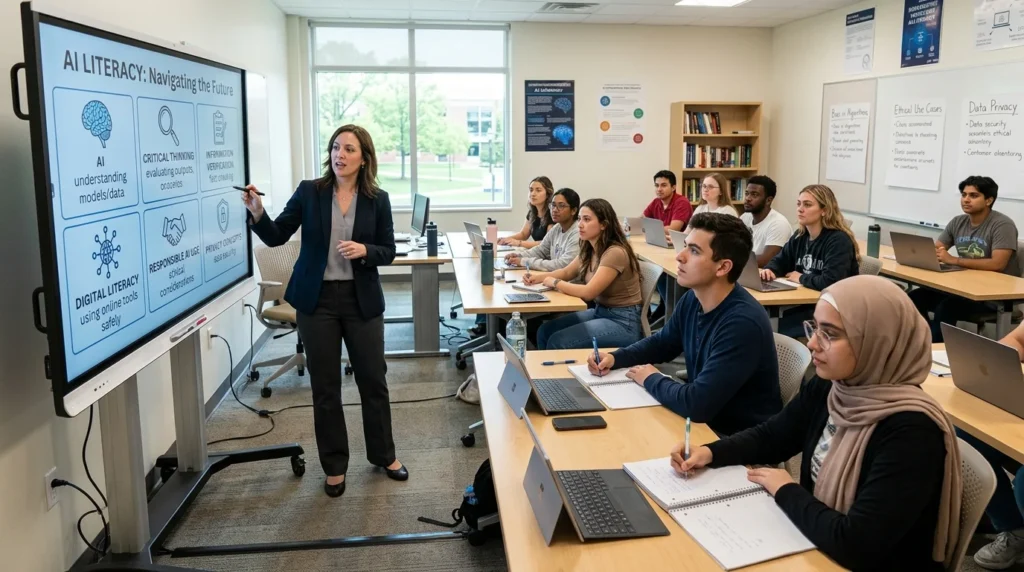
AI Literacy Is Becoming a New Education Priority
One of the education trends that will gain even more popularity in 2026 is the push for literacy in artificial intelligence. Contrary to the idea of forbidding students to use these technologies, some schools are exploring ways of teaching kids to understand how such systems work, where they can fail, and how their answers should be evaluated.
According to recent news, teachers try to raise their pupils’ awareness about such issues by encouraging them to participate in classroom activities and exercises that help them identify mistakes made by AI. Moreover, students get opportunities to compare responses provided by an intelligent system with the actual information. Such an activity offers many benefits and allows learners to get closer to the topic while also learning to question the provided answers and even utilize those learning opportunities to develop their own ideas.
Schools Are Focusing on Responsible Technology
Education technology is also receiving greater attention from policymakers now. The US Department of Education issued new guidance on August 20, 2026, promoting schools’ concentration on whether technology is beneficial to learning, and not simply engaging students and making them spend more time on screens.
The guidance promotes giving educators a say, being transparent to parents, emphasizing outcomes for students, and protecting the privacy of students’ data. Schools are recommended to raise critical questions before adopting a particular educational technology. For instance, they should be in a position to answer what problem a given technology is supposed to solve, who are the intended beneficiaries of its use, how long it should be used, and what has been proved about its ability to improve learning.
This guidance marks a huge shift in the approach to education technology. A new AI tool can be impressive. Nevertheless, schools are now required to ensure that it provides some substantive educational value.
Teachers Need AI Skills Too
A teacher’s role in society is not only to convey knowledge to their students, but to be able to adapt and use new technologies in their classroom. In the UAE alone, over 24,000 educators and teaching support staff have been trained before the 2026-27 academic year begins to teach leadership, AI, and inclusive practices. Other countries, such as Kerala in India have also begun developing a curriculum for teachers, and plans to prioritize teaching methodology, as well as including aspects of AI and other technologies into their education systems.
Teacher training is crucial to ensure that technology isn’t used in classrooms without proper guidance. A lesson using a piece of technology isn’t automatically better than a lesson without one. Teachers need to know when a tool is being useful, and when it’s just wasting their students’ time.
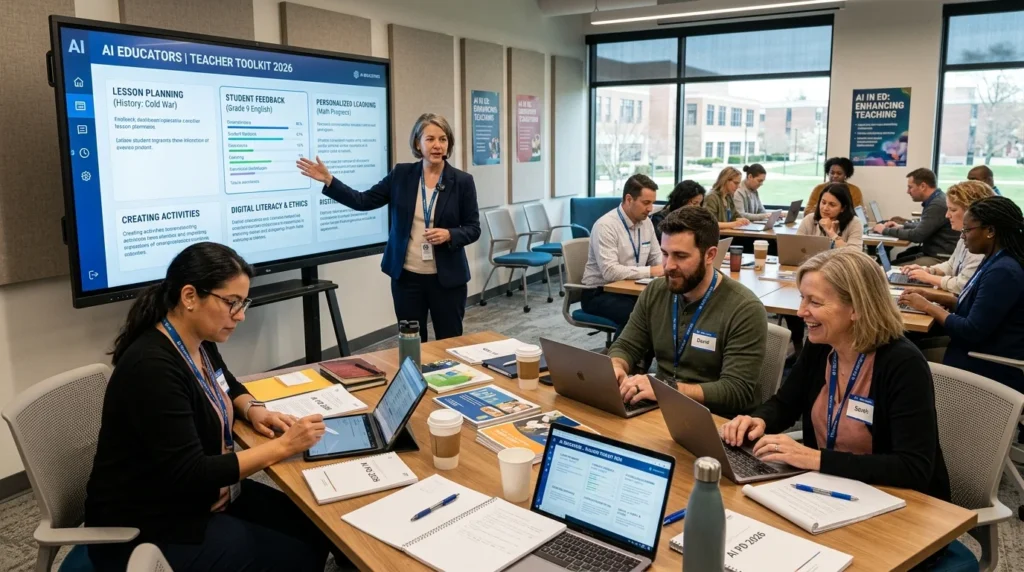
AI Is Changing How Students Are Assessed
Generative AI also poses challenges to schools and universities when it comes to assignments and exams. If AI can come up with an essay or solve a math problem in seconds, simply requiring students to complete these tasks at home may not effectively test their knowledge. Universities are therefore considering alternative forms of assessment that focus more on critical thinking, laboratory work, class discussions, presentations and other activities that require explanation of the solution process. The recent work from MIT on AI and education also highlights the need for curricular, instructional, and appraisal innovations in education as well as new forms of teacher support.
It does not propose that traditional assignments are entirely abandoned, but that they can be supplemented with alternate activities that allow educators to evaluate their students’ learning and problem-solving proficiency.
Critical Thinking Is More Important Than Ever
The increasing accessibility of AI requires that students learn to think critically more than ever before. In an age when students can get explanations, summaries, ideas and even answers at the touch of a button, speed is no longer the issue: accuracy is. The problem with AI is that it can give wrong information, sometimes confidently, and students have to be able to check, compare, detect errors, and arrive at their own conclusions, therefore requiring a whole new set of skills. This is why AI literacy is increasingly linked to digital literacy. The idea is not to make students ‘use’ AI, rather to make them ‘useful’ with AI.
Digital Student Records Are Expanding
Education technology is also transforming school administration, as Pakistan’s Sindh province has recently scaled up its Student Attendance Monitoring and Redress System to cover 3,647 government schools in the country. The system aims to keep digital records of attendance, grades, exams, and transfers. Besides that, it can detect long-term absences and potential dropouts. The system provides a range of tools, including student IDs, QR tags, attendance reports, and parent notifications. Offline student tracking and QR code attendance are also available for schools with weak internet connection. Such technologies may help make education administration more efficient while providing authorities with more information on attendance and dropout rates. Yet, the security of students’ data will have to be of a key priority, now that more and more records are being digitalized.
Universities Are Preparing for an AI-Driven Future
Higher education is another area in which education is being revolutionized by artificial intelligence. Universities worldwide are grappling with the implications of integrating artificial intelligence into curricula, research, examinations, and training. The World Economic Forum has issued a caution that educational systems must be designed to harness technologies that enhance human learning, equity, and trust rather than diminish them, according to its 2026 education report. The report’s themes include governance, infrastructure, pedagogy, assessment, integrity, and human connection.
Meanwhile, UNESCO is also preparing for broader conversations on artificial intelligence and education as its Digital Learning Week, themed Education in the age of AI: Facts | Frictions | Frontiers, will be held on September 8-11, 2026. Over 25 ministers of education and experts are expected to attend the event.

The Digital Divide Remains a Challenge
Technology can be used to generate new opportunities, but not every student has equal opportunities to obtain devices, access the Internet, use online educational tools, and work with qualified instructors. UNESCO still insists on the importance of digital inclusion because the absence of high technology platforms in education systems creates barriers to learning for disadvantaged individuals, and access to technology alone is not enough; students need proper educational resources and professional teaching staff to get the necessary knowledge and skills.
Therefore, it is important to note that future education policies should address both problems of adopting artificial intelligence in schools and universities and ensuring the equal chances of accessing a wide range of educational resources.
What Students Should Learn in 2026
Students entering an increasingly AI-centric world should be prepared with more than just traditional academic subjects. In addition to their academic knowledge, students should develop digital literacy, research, communication, creativity, and critical thinking skills. At the same time, learning how to write effective AI prompts can be valuable. However, students should also learn how to fact-check AI-generated information, understand privacy risks, and recognize situations where using AI may not be appropriate. As a result, the goal should be to help students use AI as a learning tool while continuing to develop their own independent thinking skills.Most importantly, students must learn skills that an AI will not necessarily be able to replace. Independent thought, creativity, communication, collaboration, and problem solving skills will always be valuable in an increasingly technological world.
What Does AI Mean for the Future of Education?
AI would not likely eliminate the roles teachers and education as a whole play. Instead, it would integrate into the classroom and change things slightly. Teachers would start relying on it for lesson planning, teaching, and organization while students would be likely to use AI as a tool to learn with, and prove their knowledge to the teacher. The biggest issue would be to find a balance. School systems should integrate AI wisely to get the most out of it, not let it take over the student’s life, or the teacher’s job.

Final Thoughts
Education in 2026 is set to enter a new era as artificial intelligence becomes a regular part of classroom learning. From AI literacy and pedagogy to electronic record keeping and novel approaches to examination, technology is changing both the classroom environment and educational administration practices.But most successful will be the integration of the appropriate technologies for a particular educational need. Students still need teachers, critical thinking, creativity, and human interaction, all of which can be facilitated by AI. While schools and universities continue to evolve with artificial intelligence, educational practices centered around responsible use, student privacy, accessibility, and effective learning are likely to drive the future of education technology discussions.
FAQs
How is AI changing education in 2026?
AI is supporting personalized learning, teaching, assessment, research, and education management.
What is AI literacy?
AI literacy means understanding how AI works, its limitations, risks, and responsible use.
Will AI replace teachers?
AI tools are being developed and taught as an aid and supplement to teachers.
Why do students need to learn critical thinking skills with AI?
They need to learn how to evaluate the information provided by an AI because sometimes they can give incorrect information
Are schools using AI in classrooms?
Yes. Many schools are introducing AI literacy and controlled classroom use.
How is AI affecting university education?
Universities are reviewing courses, assessments, research, and teaching methods because of AI.
What skills should students develop?
Critical thinking, creativity, communication, digital literacy, research, and problem-solving are increasingly important.